Silk Mandir · Our House
Our House വീട്
A two-shelf store, thirty years ago.
മൂന്ന് നിലകൾ · ഒരു വാഗ്ദാനം
How a small Kanjeevaram counter on Mavoor Road grew into a three-floor house of silks — and what we still do exactly the same way as we did on the first morning in 1996.
Part 01 · The beginning ആരംഭം
Mavoor Road, 1996.
The first shop was twelve feet wide. Two shelves of Kanjeevaram, one shelf of Banarasi, a folding chair for customers, and a small puja corner for Lakshmi. Mavoor Road in those days wasn't what it is now — there was no flyover, the auto-rickshaws still negotiated, and the Soubhagya apartments opposite hadn't gone up yet. We opened at 10 in the morning and shut at 9, exactly the way we still do.
The first month, we did ₹8,400. The second month, we did ₹6,200, because there was a wedding-season lull. The third month was Onam, and we sold our entire Balaramapuram kasavu stock in eleven days. That's when we knew it had to be a house, not a shop. A house for silk.
By the second year we'd added the mezzanine — for daily anarkali and three-piece. By the seventh year we'd added the third floor for bridal. By 2010 the family travelled twice a year to the looms, and the buying ledger started getting kept in three languages.
"A saree should be tried, draped, walked in, sat in — only then does it choose you. Anything else is a packet, not a saree."
Part 02 · The promise വാഗ്ദാനം
Three things, since the first morning.
The promise has been the same for thirty years. First, nothing on the rack you haven't seen first — we don't sell a saree from a sealed packet. Second, nothing on you that doesn't sit right — we drape it, photograph it, let you walk in it before we bill. Third, tea while the boxes come out — because choosing a saree is conversation, not transaction.
These aren't slogans. They're the reason customers' daughters now bring their daughters to the shop. The grandmother who bought her muhurtham Kanjeevaram from us in 1998 is still on the third floor today, picking a wedding-saree for a niece. The same chair, sometimes.
We also do four things less visibly. The blouse fitting is in-house — the same tailor since 2004. The fall-and-pico is done before the saree leaves. The trousseau ledger stays open in your name. And we will, with absolutely no shame, tell you a saree doesn't suit you. That last one is harder than it sounds.
Part 03 · The looms തറികൾ
Nine regions, forty looms, two visits a year.
Twice a year, between April and June and again between September and November, the family travels — Kanchipuram first, then Banaras, then a slow loop through Patan, Mysore, Pochampally, Paithan, Bhagalpur, Chanderi. Balaramapuram and Chendamangalam are closer, so Kerala kasavu gets bought on shorter trips through the year.
We've been buying from the same families on most of these looms for over a decade. There are seven Kanjeevaram weavers we work with directly; four Banarasi families; two Patola houses; and one stubborn old weaver in Paithan who only sells if the family comes in person — not the buyer, the family. Most of these names are written on the inside of every saree label, the way they always have been.
The looms tell us what they're weaving this season. We tell them what our brides are asking for. Sometimes a colour, sometimes a motif, sometimes a request for a 1-inch border instead of 3 — and the looms work it out across the year. That's why our shelves rotate — what was here in March isn't here in October.
Part 04 · The shop കട
Three floors, one staircase, three smells.
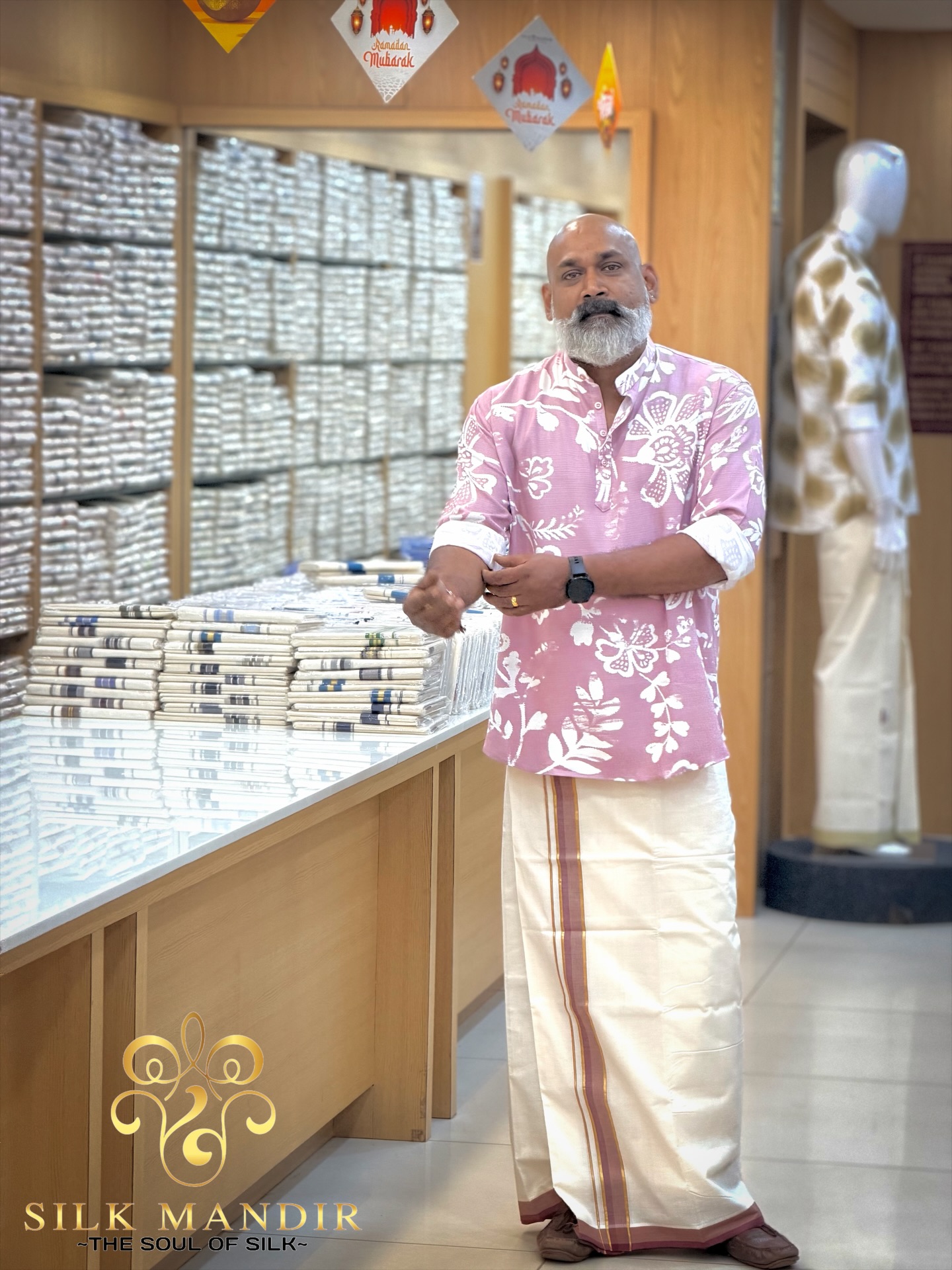
The ground floor smells like silk and a faint trace of sandalwood — that's the silk room. Kanjeevaram, Banarasi, kasavu, Mysore. Two hundred sarees on open shelves, sorted by weave and weft count. This is also the room where the puja happens at 9.45 every morning, just before the doors open.
The mezzanine smells like cotton and printed mul, plus very faintly of the tailor's room behind the back wall. Daily anarkalis, kurti sets, three-piece. Lighter rooms, faster decisions. Most women come here weekly and stay forty minutes.
The third floor smells like new wood and dried sandalwood — that's because the trousseau trunks are stored here, and the trunks are made of Kerala teak and lined with sandalwood-soaked muslin. This is the bridal room. Tea arrives by the second visit, by name. The third floor is where the boxes come out, and where the families spend three afternoons.
"We don't sell sarees. We open boxes until one looks back at you."
Part 05 · What's next അടുത്തത്
The next thirty years look a lot like the last thirty.
We have no plans to put the entire catalogue online. We have no plans to franchise. We have no plans to open in a mall. None of those would make the shop better — they would only make it bigger, which is a different thing. What we will do is keep buying from the same families, keep opening the boxes, keep the third floor air-conditioned, keep the tea warm.
If the daughter of a bride from 1999 walks in tomorrow with a niece, we want her to see the same chair, the same staircase, the same puja corner. The cloth is what changes — slowly, with the season. The room shouldn't.
So if you've come this far down the page — thank you. Now come up to the third floor. The tea is ready.
Come and see വന്നു കാണുക